Resilient Innovation for Sustainable Karst Water Management under Environmental Stress - RISE
Project Team
Dr. Blaž Kogovšek, Dr. Cyril Mayaud, Dr. Janez Mulec, Dr. Metka Petrič-
ARIS Project ID
J2-70094
-
Duration
1 April 2026–31 March 2029 -
Lead Partner
Inštitut za raziskovanje krasa Znanstvenoraziskovalni center Slovenske akademij…
-
Project Leader
-
Financial Source
Javna agencija za znanstvenoraziskovalno in inovacijsko dejavnost Republike Slovenije (ARIS)

Partners
Freie Universität Berlin
The proposed project contributes to scientific understanding by addressing urgent challenges related to environmental change and the protection of vital natural resources. It focuses on karst hydrology and addresses issues such as water management, climate change and human pressures. Karst aquifers, which provide a significant proportion of the world’s freshwater, are highly vulnerable to contamination and overexploitation and require sustainable management that is in line with global priorities such as the United Nations SDGs. The project aims to contribute to critical knowledge gaps and develop globally applicable innovative solutions.
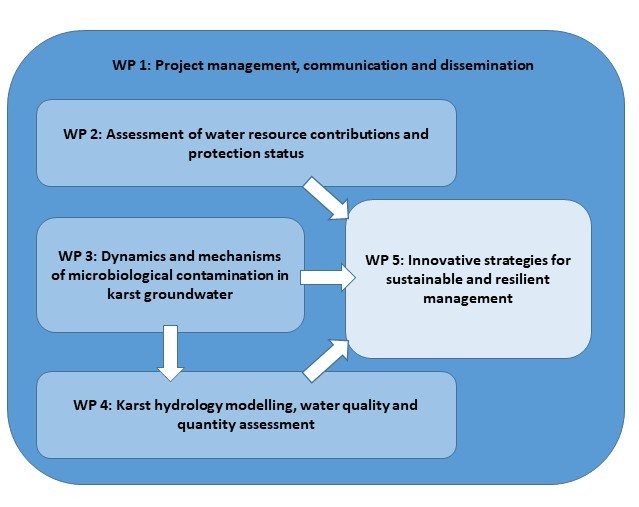
A key innovation is the creation of a GIS-based database that will collect detailed data on karst water resources. This database will provide information on resource distribution, protection status and investment priorities and enable evidence-based decision making for long-term water security. By identifying resources in need of immediate protection, it will represent a significant advance in the management of karst aquifers.
The project will utilise advanced methods including continuous monitoring of microbial indicators, suspended particles, sediment profiling and laser-based microscopic analysis. These approaches will provide new insights into contaminant transport and turbidity in karst systems. Machine learning will be used to identify proxy contamination parameters that will enable the development of a real-time early warning system.
Innovative modelling of karst spring discharge using sub-unit divisions for models with lumped parameters will overcome the limitations of aggregated data and improve accuracy, especially under extreme conditions such as floods and droughts. Data from individual springs will improve the understanding of karst responses to climate variability and human activities.
The interdisciplinary approach integrates karstology, hydrology, microbiology and predictive modelling to ensure a comprehensive understanding of karst systems and their vulnerability. By combining advanced hydrological monitoring, artificial intelligence and numerical modelling, the project provides a holistic perspective for the sustainable management of karst aquifers.
The results will include globally relevant predictive tools to mitigate contamination risks and improve the resilience of water supplies. Stakeholder engagement, workshops, publications and policy recommendations will ensure that the results inform scientific research and water management practise and support global efforts to achieve clean water and protect critical freshwater resources.
With its innovative methods, interdisciplinary approach and global significance, the project is at the forefront of karst hydrology research. It contributes to scientific knowledge while providing practical solutions to water-related challenges in terms of local and global sustainability.